|
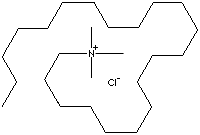
BEHENTRIMONIUM CHLORIDE | ||
|
PRODUCT IDENTIFICATION |
||
| CAS NO. | 17301-53-0 |
|
| EINECS NO. | 241-327-0 | |
| FORMULA | CH3(CH2)21N(Cl)(CH3)3 | |
| MOL WT. | 404.16 | |
|
H.S. CODE |
2923.90 | |
|
TOXICITY |
||
| SYNONYMS | Docosanyl Trimethylammonium Chloride; | |
| Behentrimonium Chloride; n,n,n-Trimethyl-Behenyl aminium chloride; Behenyl Trimethyl Ammonium Chloride; Behentrimonium Chloride; | ||
| PRICE | ||
|
CLASSIFICATION |
||
|
PHYSICAL AND CHEMICAL PROPERTIES |
||
| PHYSICAL STATE | light yellow solid | |
|
MELTING POINT |
||
| BOILING POINT | ||
| SPECIFIC GRAVITY | ||
|
SOLUBILITY IN WATER |
soluble | |
| pH | 6 - 8 | |
| VAPOR DENSITY | ||
|
REFRACTIVE INDEX |
| |
| NFPA RATINGS | Health: 2; Flammability: 0; Reactivity: 0 | |
| FLASH POINT |
| |
| STABILITY | Stable under ordinary conditions | |
|
APPLICATIONS |
||
| Active Ingredient for Conditioners, Antistatic Agent, Detergent Sanitisers, softner. Behenyl Trimethyl Ammonium Chloride is used in organic synthesis as a phase transfer catalyst to enhance the reaction rate of a two-phase organic-water system and as an intermediate. Quaternary ammonium salts are used for formulating antimicrobials, disinfection agents and sanitizers. It acts as a slimicidal agents and algaecide for industrial water treatment. | ||
| SALES SPECIFICATION | ||
|
APPEARANCE |
light yellow flakes | |
| ACTIVE CONTENT | 79.0 - 81.0% | |
| pH | 6.0 - 8.0 | |
| COLOR, GARDNER | 3 max | |
| FREE AMINE |
1.0% max | |
|
FREE AMINE HCl |
1.0% max | |
| TRANSPORTATION | ||
| PACKING | 25kgs in Drum | |
| HAZARD CLASS | 8(9.2) | |
| UN NO. | 1759 | |
| OTHER INFORMATION | ||
| European Hazard Symbols: XN, Risk Phrases: 22-36/37/38, Safety Phrases: 25-36/37/39-45 | ||
|
GENERAL DESCRIPTION OF PHASE TRANSFER CATALYSIS |
||
|
'Phase transfer catalysis (PTC)' methodology is a powerful tool improving
process efficiency, product selectivity and providing mild reaction conditions
in organic chemical reactions. In many chemical reaction situations, there are
different species (immiscible liquids or solid and liquid) which don't react
each othrer due to separattion by an interface. Small quantity of
¡®phase-transfer catalyst¡¯, involves a substrate (soluble in the organic layer)
and an anionic reagent or a nucleophile (dissolved in the aqueous layer),
extracts one of the reactants, most commonly an anion, across the interface into
the other phase where reaction can take place with the substrate and reaction
can proceed. The quaternary ammonium salts can carry the nucleophile from the
aqueous to organic phase and are used as the most commonly used as
phase-transfer catalyst. The phosphonium derivatives favoring higher thermal
stability property are also used. Crown ethers and polyethylenglycol compounds
are also widely used in this application. |
||
| GENERAL DESCRIPTION OF DISINFECTANT | ||
Disinfectant is
an agent applied to inanimate objects to destroy, neutralize, or inhibit the
growth of disease-carrying microorganisms, (whereas antiseptics are applied
primarily to living things). Heat and radiation are also disinfectants. Common
ingredients of chemical disinfectant are:
|
||