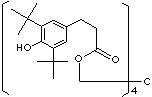
| TETRAKIS(3-(3',5'-DI-TERT-BUTYL-4'-HYDROXYPHENYL) PENTAERYTHRITOL | ||
|
PRODUCT IDENTIFICATION |
||
|
CAS NO. |
6683-19-8 |
|
| EINECS NO. | 229-722-6 | |
| FORMULA | [HOC6H2[C(CH3)3]2CH2CH2CO2CH2]4C | |
| MOL WT. | 1177.67 | |
| H.S. CODE | 2918.29.0090 | |
| TOXICITY |
Oral rat LD50: 2000 mg/kg | |
| SYNONYMS | Irganox 1010; Anox 20; | |
| Benzenepropanoic acid, 3,5-bis(1,1-dimethylethyl)-4-hydroxy-,2,2-bis[[3-[3,5-bis (1,1-dimethylethyl)-4-hydroxyphenyl]-1-oxopropoxy]methyl]-1,3-propanediyl ester; Tetrakis(((beta-(3,5-di-tert-butyl-4-hydroxyphenyl)propionyl)oxy) methyl)methane; Neopentanetetrayl 3,5-di- tert-butyl-4-hydroxyhydrocinnamate; Pentaerythritol tetrakis(3-(3,5-di-tert-butyl-4-hydroxy phenyl)propionate); Tetrakis(3-(3,5-di-terc-butil-4-hidroxifenil) propionato) de pentaeritritol; Tétrakis(3-(3,5-di-tert-butyl-4-hydroxyphényl)propionate) de pentaérythritol; Neopentanetetrayl 3,5-di-tert-butyl-4-hydroxyhydrocinnamate; , Other RN: 5106-16-1; 12634-41-2; 60005-82-5; 67894-72-8; 68882-58-6; 70695-00-0; 98584-37-3; 103843-13-6; 127337-64-8; 131611-06-8; 132503-83-4; 137500-49-3; 145526-73-4; 154508-64-2; 156511-60-3; 678997-54-1; 702667-02-5; 913283-07-5; |
||
| SMILES |
c1(c(C(C)(C)C)cc(CCC(OCC(COC(CCc2cc(c(c(C(C)(C)C)c2) O)C(C)(C)C)=O)(COC(CCc2cc(c(c(c2)C(C)(C)C)O)C(C)(C)C)= O)COC(CCc2cc(c(c(c2)C(C)(C)C)O)C(C)(C)C)=O)=O)cc1C(C)(C)C)O | |
|
CLASSIFICATION |
Hindered phenol, Antioxidant, Stabilizer |
|
|
PHYSICAL AND CHEMICAL PROPERTIES |
||
| PHYSICAL STATE | White to slightly yellowish crystalline powder | |
| MELTING POINT |
115 C | |
| BOILING POINT | ||
| SPECIFIC GRAVITY |
| |
| SOLUBILITY IN WATER |
Negligible | |
| SOLVENT SOLUBILITY |
Soluble in almost organic solvents. Slightly soluble in methanol. | |
| AUTOIGNITION | ||
| NFPA RATINGS | ||
| FLASH POINT | ||
| STABILITY | Stable under normal temperatures and conditions | |
|
GENERAL DESCRIPTION & EXTERNAL LINKS |
||
|
Antioxidant is a substance added in small quantities to hydrocarbons which are
susceptible to oxidation, such as rubbers, plastics, foods, and oils to inhibit
or slow oxidative processes, while being itself oxidized. Antioxidants work in
two different ways. In primary antioxidants (also called free-radical
scavengers), antioxidative activity is implemented by the donation of an
electron or hydrogen atom to a radical derivative. These antioxidants are
usually hindered amines (p-Phenylene diamine, trimethyl dihydroquinolines,
alkylated diphenyl amines) or substituted phenolic compounds with one or more
bulky functional groups such as a tertiary butyl at 2,6 position commonly.
Butylated hydroxytoluene (BHT) is a common example of hindered phenolic
antioxidant. The reaction rate, or carbocation stability, in SN1 mechanism is 3° > 2° > 1° > CH3
(no SN1) so, tertiary alkyl moiety exists in lots of phenolic antioxidant
compounds. Primary antioxidants are free radical scavengers which combine with
peroxy radicals and break autocatalytic cycle. In secondary antioxidants ( also
called peroxide decomposers), activity is implemented by the removal of an
oxidative catalyst and the consequent prevention of the initiation of oxidation.
Examples of peroxide decomposer type of antioxidant are trivalent phosphorous
and divalent sulfurcontaining compound such as sulfides, thiodipropionates and
organophosphites. Synergistic effect is expected when primary antioxidants are
used together with secondary antioxidants as primary antioxidants are not very
effective against the degradation by UV oxidation. Sometimes, chelating agents
are added to scavenge metal impurities which can initiate decomposition.
Tetrakis(3-(3',5'-di-tert-butyl-4'-hydroxyphenyl) pentaerythritol is a hindered phenolic antioxidant with a wide range of application against themo-oxidative degradation for polymers, synthetic fibers, elastomers, adhesives and waxes without discoloring. http://www.thefreelibrary.com/ http://www.songwonind.com/ Hindered Aminic Light Stabilizer(SONGLIGHT®) protect polymers from degradation due to uv radiation and long term heat aging. UV Absorber(SONGSORB®) absorbs ultraviolet radiation and through a reversible chemical rearrangement, dissipates the energy as heat. |
||
| SALES SPECIFICATION | ||
|
APPEARANCE |
White to slightly yellowish crystalline powder | |
| PURITY (G.C.) |
98.0% min | |
|
TRANSMISSION |
95% min (425nm), 97% min (500nm) | |
|
VOLATILITY |
0.5% max ( 2h/105 C) | |
| TRANSPORTATION | ||
| PACKING | 25kgs in bag | |
| HAZARD CLASS | ||
| UN NO. | ||
| REMARKS | ||
|
Other
Phenolic Antioxidant:
|
||