PRODUCT IDENTIFICATION
H.S. CODE
TOXICITY
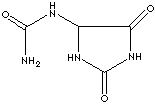
C1(NC(=O)NC1=O)NC(=O)N
CLASSIFICATION
Dermatologic agent, Vulnerary, Cosmetics chemical, Urea, Excipient, Hydantoin
EXTRA NOTES
Oxidation of Uric acid
Other RN: 5377-33-3, 37305-69-4, 58308-55-7
PHYSICAL AND CHEMICAL PROPERTIES
0.5% at 25 C (freely disolve in alkalis)
REFRACTIVE INDEX
Stable under ordinary conditions
GENERAL DESCRIPTION & APPLICATIONS
USA.gov - Allantoin
Wikipedia Linking - Allantoin
Google Scholar Search - Allantoin
Drug Information Portal (U.S. National Library of Medicine) - Allantoin
PubChem Compound Summary - Allantoin
Drug Bank - Allantoin
KEGG (Kyoto Encyclopedia of Genes and Genomes) - Allantoin
http://www.ebi.ac.uk/chebi/ - Allantoin
http://www.ncbi.nlm.nih.gov/ - Allantoin
Material Safety Data Sheet - Allantoin
Hazardous Substances Data Bank - Allantoin
EPA - Substance Registry Services - Allantoin
Local:
Allantoin, the
diureide of glyoxylic acid, is a crystallizable oxidation product of uric acid
found in allantoic and amniotic fluids, in fetal urine and in many plants.
(Ureide is a compound derived from urea and contains acid radicles. Those from
one molecule of urea, as alloxan, are monoureides; those derived from two, as
uric acid, are diureides). Allantoin is an urinary excretion product of purine
metabolism in most mammals but not in higher apes including humans. It is
produced synthetically by the oxidation of uric acid. Allantoin is active in
skin-softening (keratolytic effect) and rapid cell regeneration by precipitating
proteins on skin. It is used as an abrasive and astringent agent in the end
products include cosmetic lotions, creams, suntan products, scalp preparations,
shampoos , lipsticks and and various aerosol preparations. It is used in topical
pharmaceutical preparations. Allantoin has been used in various oral hygeine
preparations such as toothpaste and mouthwash as well as in eye drops to treat
watering eyes and in ear drops to clean the ear canal. Alloxan
is an oxidized product of uric acid by nitric acid. When administered to experimental animals,
it produces selective destruction of the beta
cells of the pancreas, causing hyperglycemia and ketoacidosis. Alloxan,
a strong oxidizing
agent, and its reduced product dialuric acid form alloxantin (a hemiacetal)
which is used as a raw material to produce ammonium purpurate dye,
murexide (C8H5N5O6·NH3)
with heating at 100 C in ammonia gas. Murexide is used as a
complexometric titration indicator and as a colorimetric reagent for measurement of calcium and
rare earth metals.
|
Product |
CAS RN. |
| Alloxan | 50-71-5 |
| Alloxantin | 76-24-4 |
| Violuric acid | 87-39-8 |
| Alloxanic acid | 470-44-0 |
| Violuric acid monosodium salt |
825-29-6 |
| Alloxan monohydrate | 2244-11-3 |
| Oxypurinol | 2465-59-0 |
| 1,3-Dimethylalloxan | 2757-85-9 |
| 2,4,5,6(1H,3H)-Pyrimidinetetrone hydrate | 3237-50-1 |
| Alloxanthin | 28380-31-6 |
| 5-((4-Methoxy-2-nitrophenyl)hydrazone) alloxan | 31353-87-4 |
| 1-Phenylvioluric acid | 82628-28-2 |
|
|
APPEARANCE
ASSAY
MELTING POINT
255 C min
IRON
10ppm max
ARSENIC
3ppm max
UREA
0.5% max
GLYOXYLIC ACID
0.5% max
SULFATED ASH
0.1% max