PRODUCT IDENTIFICATION
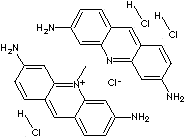
69235-50-3 (Acriflavine HCl)
H.S. CODE
TOXICITY
SMILES
c12c([n+](c3cc(N)ccc3c1)C)cc(N)cc2.c12c(nc3cc(N)ccc3c1)cc (N)cc 2.[ClH-]
CLASSIFICATION
Antiseptic, Fluorescent Dye, Indicator
EXTRA NOTES
EPA Pesticide Chemical Code 000501
Overall Carcinogenic Evaluation: Group 3
3,6-Diamino-10-methylacridinium chloride mixt. with 3,6-acridinediamine. Fluorescent dye used as a local antiseptic and also as a biological stain. It intercalates into nucleic acids thereby inhibiting bacterial and viral replication. [MeSH]
Other RN: 8018-07-3, 8063-24-9, 50922-89-9, 51367-34-1
PHYSICAL AND CHEMICAL PROPERTIES
250 (g/l)
SOLVENT SOLUBILITY
REFRACTIVE INDEX
Stable under ordinary conditions. Light sensitive.
EXTERNAL LINKS & GENERAL DESCRIPTION
USA.gov - Acriflavine
Wikipedia Linking - Acriflavine
Google Scholar Search - Acriflavine
U.S. National Library of Medicine - Acriflavine
PubChem Compound Summary - Acriflavine
Drug Bank - Acriflavine
KEGG (Kyoto Encyclopedia of Genes and Genomes) - Acriflavine
http://www.ncbi.nlm.nih.gov/ - Acriflavine
Material Safety Data Sheet - Acriflavine
EPA - Substance Registry Services - Acriflavine
Local:
Acridine is
a C13N tricycle compound comprising two benzene
rings joined side by side by pyridine skeleton, which is structurally related to anthracene.
The central CH group is
replaced by nitrogen. Acridine and its derivatives are basic substances for the
production of dyes.
They are also used as a starting material
for the production of some
drugs. Acridine is used for vital
and supravital
staining for the detection of nucleic acids, differentiation of DNA and
RNA, and detection of malignant cells. Acridine Orange (3,6-dimethylaminoacridine) is a nucleic acid-selective metachromatic stain useful
for cell cycle determination.
Acridine can be obtained by extraction from coal tar and there are several synthetic methods are known (e.g. condensation of diphenylamine with carboxylic acid or chloroform. cyclisation of N-phenylanthranilic acid or 2-(phenylamino)benzoic acid with phosphoric acid, and Lehmstedt-Tanasescu reaction). Acridine and its homologues have antiseptic properties. They bind to DNA and RNA and cause the reversible inclusion of nucleic acids. Proflavine (3,6-diaminoacridine) and acriflavine ( the mixture of 3,6-diaminoacridine chloride and 3,6-diamino-10-methylacridinium chloride) are examples used as an antiseptic agent. Acriflavine is a fluorescent dye used as a biological stain and as a local antiseptic agent for the skin and mucous membranes. It is known to inhibit mitochondriogenesis. Both acriflavin and proflavin having dibenzopyridine structure are used in the synthesis dyes and drugs.
Molecular compounds of Proflavine
|
Product |
CAS RN |
| Chromoflavine | 86-40-8 |
| Acridine Yellow | 92-26-2 |
| Proflavine | 92-62-6 |
| Ethacridine | 442-16-0 |
| Benzoflavine | 477-74-7 |
| Proflavine dihydrochloride | 531-73-7 |
| Proflavine sulfate | 553-30-0 |
| 3,9-Diaminoacridine | 951-80-4 |
| Proflavine hydrochloride | 952-23-8 |
| Proflavine hemisulfate | 1811-28-5 |
| Ethacridine lactate | 1837-57-6 |
| Diflavine | 3407-94-1 |
| Trypaflavine hydrochloride | 6034-59-9 |
| 3,6-Diaminoacridine hydrochloride | 7459-75-8 |
| Xanthacridinum | 8048-52-0 |
| Acriflavine dihydrochloride | 8063-24-9 |
| Tetramethylacriflavine | 20195-94-2 |
| 2,9-Diaminoacridine | 23043-62-1 |
| 1,9-Diaminoacridine | 23043-60-9 |
| 2,7-Diaminoacridine | 23043-63-2 |
| 2,7-Di-tert-butyl proflavine | 33244-11-0 |
| 3,8-Diaminoacridine | 40504-84-5 |
| 3,5-Diaminoacridine | 40505-25-7 |
| 2,7-Diaminoacridine hydrochloride | 64046-84-0 |
| Acriflavine | 65589-70-0 |
| Acriflavine hydrochloride | 69235-50-3 |
| Iodoproflavine | 74165-93-8 |
| N-Methylproflavine | 101952-51-6 |
| N-Propylproflavine | 101952-43-6 |
| N-Butylproflavine | 101952-50-5 |
| 3-Acetamido-5-iodoproflavine | 121284-42-2 |
APPEARANCE
DYES CONTENT
90.0% min
HAZARD OVERVIEW
GHS (Globally Harmonised System) Classification: Acute toxicity (Oral). Skin irritation. Eye irritation. Specific target organ toxicity - single exposure. Acute aquatic toxicity. Hazard statements: Harmful if swallowed. Causes skin irritation. Causes serious eye irritation. May cause respiratory irritation. Toxic to aquatic life.
GHS
Warning
PICTOGRAMS


HAZARD STATEMENTS
H302-H315-H319-H335-H401
P STATEMENTS
P261-P305 + P351 + P338


RISK PHRASES
22-36/37/38-50
SAFETY PHRASES
26-36/37/39-61