|
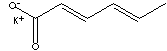
POTASSIUM SORBATE |
||
|
PRODUCT IDENTIFICATION |
||
| CAS NO. | 590-00-1 |
|
| EINECS NO. | 246-376-1 | |
| FORMULA | CH3CH=CHCH=CHCOOK | |
| MOL WT. | 150.22 | |
|
H.S. CODE |
2916.19.1000 | |
|
TOXICITY |
Oral rat LD50: 4340 mg/kg | |
| SYNONYMS |
Sorbic acid potassium salt; Potassium 2,4-hexadienoate; |
|
|
2,4-Hexadienoic aAcid potassium salt; Sorbistat; Sorbistat-K; Sorbistat-potassium; Potassium sorbate; Other RN: 16577-94-9, 24634-61-5 |
||
| SMILES | C(=C\C=C\C)\C(=O)[O-].[K+] | |
|
CLASSIFICATION |
Antimicrobial agent, Preservative, Fungicide, Bactericide | |
|
EXTRA NOTES |
EPA Pesticide Chemical Code 075902 FEMA No. 2921 Its primary use is as a food preservative (E number 202). |
|
|
PHYSICAL AND CHEMICAL PROPERTIES |
||
| PHYSICAL STATE |
white to slightly yellow crystalline powder or Granular |
|
| MELTING POINT | 270 C (Decomposes) | |
| BOILING POINT |
|
|
| SPECIFIC GRAVITY | 1.363 | |
| SOLUBILITY IN WATER | 58.5g/100ml | |
| SOLVENT SOLUBILITY |
Soluble in ethanol, propylene glycol. Slightly soluble in acetone. |
|
| pH | ||
| VAPOR DENSITY |
|
|
|
AUTOIGNITION |
|
|
|
NFPA RATINGS |
Health: 0 Flammability: 1 Reactivity: 1 | |
|
REFRACTIVE INDEX |
|
|
| FLASH POINT |
|
|
| STABILITY | Stable under ordinary conditions | |
|
EXTERNAL LINKS & GENERAL DESCRIPTION |
||
|
Drug Information Portal (U.S. National Library of Medicine) - Potassium sorbate PubChem Compound Summary - Potassium sorbate IPCS INCHEM - Potassium sorbate KEGG (Kyoto Encyclopedia of Genes and Genomes) - Potassium sorbate http://www.ebi.ac.uk/ - Potassium sorbate http://www.ncbi.nlm.nih.gov/ - Potassium sorbate Local: Potassium Sorbate is used as a mold, bacterial and yeast inhibitor and as a fungistatic agent in foods. It is also used in cosmetics, pharmaceutical, tobacco and flavoring products. In wines, it is to prevent the secondary fermentation of residual sugar. It is used in coating to improve gloss. It is used as an intermediate to manufacture plasticizers and lubricants.. It is used as an additive in rubber industry to improve milling characteristics.
|
||
| SALES SPECIFICATION | ||
|
BIBLIOGRAPHY |
FCC IV |
|
|
APPEARANCE |
White Granular |
|
|
CONTENT |
98.0~101.0 |
|
|
WATER |
1.0% max |
|
|
ALKALI (as K2CO3) |
1.0% max |
|
|
ACID (as SORBIC ACID) |
1.0% max |
|
|
ARSENIC (as As) |
3ppm max |
|
|
HEAVY METALS (as Pb) |
10ppm max |
|
|
LOSS ON DRYING |
1.0% max |
|
| TRANSPORTATION | ||
| PACKING |
25kgs
in fiber drum, 13mts in Container
|
|
| HAZARD CLASS | Not regulated | |
| UN NO. | ||
| SAFETY INFORMATION | ||
|
HAZARD OVERVIEW |
Causes eye, skin, and respiratory tract irritation. Target Organs: Respiratory system, eyes, skin. |
|
|
GHS |
|
|
| SIGNAL WORD | Warning | |
|
PICTOGRAMS |
|
|
|
HAZARD STATEMENTS |
H315-H319-H335 |
|
|
P STATEMENTS |
P261-P280-P302+P352-P305+P351+P338 |
|
| EC DIRECTIVES |
|
|
| HAZARD CODES |
|
|
|
RISK PHRASES |
36/37/38 |
|
|
SAFETY PHRASES |
26-37/39 |
|
|
PRICE INFORMATION |
||
|
|
||