PRODUCT IDENTIFICATION
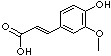
H.S. CODE
TOXICITY
SYNONYMS
c1c(c(cc(c1)/C=C/C(=O)O)OC)O
CLASSIFICATION
Carbocyclic carboxylic acid, Analgesic (Non-Narcotic), Anti-Inflammatory (Non-Steroidal), Anticoagulant, Antihypertensive, Antioxidant, Antirheumatic, Cardiovascular agent, Gastrointestinal agent, Hematologic agent,
EXTRA NOTES
Hydroxycinnamic acid found in plant-based foods. Antioxidant.
PHYSICAL AND CHEMICAL PROPERTIES
168 - 171 C
SOLVENT SOLUBILITY
soluble in alcohol and ethyl acetate
AUTOIGNITION
NFPA RATINGS
REFRACTIVE INDEX
EXTERNAL LINKS & GENERAL DESCRIPTION
Drug Information Portal (U.S. National Library of Medicine) - Ferulic acid
PubChem Compound Summary - Ferulic acid
KEGG (Kyoto Encyclopedia of Genes and Genomes) - Ferulic acid
http://www.ebi.ac.uk/ - Ferulic acid
http://www.ncbi.nlm.nih.gov/ - Ferulic acid
http://toxnet.nlm.nih.gov/
Hazardous
Substances Data Bank - Ferulic acid
Local:
Polyphenols are referred to a group of phenolic compounds which have at least
two hydroxy groups in one molecules found in plants. At a lower concentration
than that of the oxidizable substrate, polyphenols act as primary antioxidants
which inhibit or delay the oxidative processes by the donation of an electron or
hydrogen atom, resulting in the protection of cells and body before cell damage
caused by highly reactive free radicals and atoms. Polyphenols are components of
flavonoids, plant pigments, flavours of plants. Polyphenols are taken
application of free radical scavenging properties and chelating capacities for
anti-aging and cancer prevention. Ferulic
Acid, having two isomers: the cis form is a yellow oily
liquid, and the trans form is crystalline, is a powerful
membrane antioxidant to prevent free radicals in muscle
tissue. It cab be used as an UV protection agent
in skin-care products for anti-aging and anti-wrinkling.
cinnamic acid is a key intermediate in shikimate and phenylpropanoid pathways. Shikimic acid is a precursor of many alkaloids, aromatic amino acids, and indole derivatives. Phenylpropanoid are a class of plant metabolites based on phenylalanine. They are widely distributed in plants fulfilling many functions including plant defense mechanism, pigmentation and external signaling system. Phenylalanine is first converted to cinnamates, coumarines, caffeic acids, ferulic acids, and sinapic acids. Cinnamic acid is the precursor of these acids. Cinnamic acid is the parent compound of its esters which are more volatile to be transported to other parts easily. Commercial cinnamic acid, a phenylacrylic acid structure compound, is used in converting to its esters such as methyl, ethyl, and benzyl cinnamate for the perfume and flavour application. Cinnamic acid and Its derivatives including esters and carboxylic functional derivatives are used as important components in flavours, perfumes, synthetic indigo and pharmaceuticals. Cinnamate can act as optical filters or deactivate substrate molecules that have been excited by light for the protection polymers and organic substances. They, cosmetic grades, are used as sunscreen agents to reduce skin damage by blocking UV-A, B. Cinnamic acid is an odorless white crystalline powder; slightly soluble in water; melting point 133 C and boiling point 300 C.
| Ferulate |
CAS RN. |
| Isoferulic acid | 537-73-5 |
| trans-Ferulic acid | 537-98-4 |
| cis-Ferulic acid | 1014-83-1 |
| Ferulic acid | 1135-24-6 |
| 5-Hydroxyferulic acid | 1782-55-4 |
| Methyl ferulate | 2309-07-1 |
|
Acetylferulic acid |
2596-47-6 |
| Ethyl ferulate | 4046-02-0 |
| Methyl isoferulate | 16980-82-8 |
| Ferulic amide | 19272-90-3 |
| Cycloartenol ferulic acid ester | 21238-33-5 |
| Sodium ferulate | 24276-84-4 |
| Cluytyl ferulate | 35321-71-2 |
| Isopropyl ferulate | 59831-94-6 |
| Coniferyl ferulate | 63644-62-2 |
| Hexadecyl ferulate | 64190-80-3 |
| Octadecyl ferulate | 64190-81-4 |
| Icosyl ferulate | 64190-82-5 |
| Simmondsin 2'-ferulate | 67411-22-7 |
| Glyceryl 1,3-diferulate | 83008-46-2 |
| Sodium isoferulate | 110993-57-2 |
| Glyceryl 1,2-diferulate | 126240-20-8 |
| Sibirate | 152338-47-1 |
| Ethylhexyl ferulate | 391900-25-7 |
APPEARANCE
10ppm max
PESTICIDES
2ppm max
LOSS ON DRYING
1.0% max
MICROBIOLOGOCAL TEST
Total plate count: 1000CFU/g
E. Coil: Negative
Salmonella: Negative
Yeast & Mold: 100CFU/g
HAZARD OVERVIEW
May cause eye and skin irritation. May cause respiratory and digestive tract irritation. Target Organs: None.
GHS
PICTOGRAMS

HAZARD STATEMENTS
H315-H319-H335
P STATEMENTS
P261-P305 + P351 + P338

RISK PHRASES
36/37/38
SAFETY PHRASES
26-36