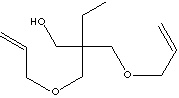
| TRIMETHYLOLPROPANE DIALLYL ETHER | ||
|
PRODUCT IDENTIFICATION |
||
| CAS NO. |
682-09-7 |
|
| EINECS NO. |
211-661-1 |
|
| FORMULA | C12H22O3 | |
| MOL WT. | 214.30 | |
| H.S. CODE | 2909.49 | |
|
TOXICITY |
Oral rat LD50: 5000 mg/kg | |
| SYNONYMS | 2,2-Bis((2-propenyloxy)methyl)-1-butanol; | |
| 2,2-Bis(allyloxymethyl)butan-1-ol; 2-Ethyl-2-(hydroxymethyl)-1,3-propanediol Diallyl ether; 2,2-Bis(aliloximetil)butan-1-ol (Spanish); 2,2-Bis(allyloxyméthyl)butane-1-ol (French); | ||
|
SMILES |
||
|
CLASSIFICATION |
|
|
|
PHYSICAL AND CHEMICAL PROPERTIES |
||
| PHYSICAL STATE |
Clear liquid |
|
| MELTING POINT | - 80 C | |
| BOILING POINT | 135 C | |
| SPECIFIC GRAVITY | 0.95 - 0.96 | |
| SOLUBILITY IN WATER | 3 g/l (soluble in alcohol, acetone) | |
| pH |
|
|
| VAPOR DENSITY | ||
| AUTOIGNITION |
|
|
| NFPA RATINGS | ||
|
REFRACTIVE INDEX |
||
| FLASH POINT |
127 C |
|
| STABILITY | Stable under ordinary conditions. Hygroscopic | |
|
APPLICATIONS |
||
| Allyl- is the
prefix for the univalent organic group, -CH2=CHCH2. Allyl alcohol is
an example, CH2=CHCH2OH, clear, pungent liquid, boiling at 96 C; soluble in
water. It is prepared from allyl chloride by hydrolysis. Allyl compound,
an alkene hydrocarbon, has a vinyl group, CH2=CH-, attached to a methylene -CH2.
Because of the highly reactive solid bond, allyl can undergo free radical addition to solid bond which
readily combine with themselves or other monomers to form homopolymers or co-polymers
which are used in the production of coatings, adhesives and elastomers. In addition
to free radical addition,
allyl compounds can participate in a wide variety of reactions
including electrophilic additions, allylic substitution
and oxidation. Allyl,
an unsaturated bond, imparts a characteristic
odor in some compounds. An example is allyl
isothiocyanate which is the main ingredient of black mustards.
(white mustard consists principally of
p-hydroxybenzyl isothiocyanate). Allyl
isothiocyanate is called mustard oil.
Allyl esters
are involved in fragrance, flavor, or odor.
Trimethylolpropane diallylether, containing one hydroxyl group and two allyl bonds in a quaternary mole structure, is a clear liquid. It is applied in unsaturated polyesters and resins (epoxy, ion-exchange and polyurethane and polyacrylate resins) to improves heat resistance, color stability, balance between toughness and flexibility. Allyl group functionality gives the advantage to inhibit oxygenation from surface tackiness in curing resins. It is also used in lubricating oils and plasticizers. |
||
| SALES SPECIFICATION | ||
|
APPEARANCE |
clear liquid |
|
|
DIALLY ETHER |
75.0 - 85.0% |
|
| MONOALLYL ETHER |
7.0 - 15.0% |
|
| TRIALLYL ETHER |
5.0 - 10.0% |
|
|
FREE OXYGEN |
6 ppm max |
|
|
COLOR, APHA |
10 max |
|
| TRANSPORTATION | ||
| PACKING | 200KGS in drum | |
| HAZARD CLASS | Not regulated | |
| UN NO. | ||
| OTHER INFORMATION | ||
| Hazard Symbols: XI, Risk Phrases: 36/37/38, Safety Phrases: 26-28 | ||