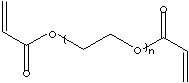
|
POLYETHYLENE GLYCOL DIACRYLATE |
||
|
PRODUCT IDENTIFICATION |
||
| CAS NO. | 26570-48-9 |
|
| EINECS NO. | ||
| FORMULA | ||
| MOL WT. | ||
|
H.S. CODE |
2916.14 | |
| TOXICITY | ||
| SYNONYMS | Poly(ethylene glycol) Diacrylate; | |
| DERIVATION |
|
|
|
CLASSIFICATION |
|
|
|
PHYSICAL AND CHEMICAL PROPERTIES |
||
| PHYSICAL STATE |
clear liquid |
|
| MELTING POINT |
|
|
| BOILING POINT | > 200 C | |
| SPECIFIC GRAVITY |
1.115 - 1.125 |
|
| SOLUBILITY IN WATER | miscible | |
| pH | ||
| VAPOR DENSITY | ||
|
AUTOIGNITION |
|
|
|
NFPA RATINGS |
||
|
REFRACTIVE INDEX |
|
|
| FLASH POINT | > 105 C | |
| STABILITY | The stability depends upon dissolved oxygen and MEHQ inhibitor. The presence of oxygen is necessary for inhibitor to prevent polymerization. | |
|
APPLICATIONS |
||
Polyethylene glycol is a condensation polymers of ethylene oxide and water with
the general formula H(OCH2CH2)nOH, where n is the average number of repeating
oxyethylene groups typically from 4 to about 180. The low molecular weight
members from n=2 to n=4 are diethylene glycol, triethylene glycol and
tetraethylene glycol respectively, which are produced as pure compounds. The low
molecular weight compounds upto 700 are colorless, odorless viscous liquids with
a freezing point from -10 C (diethylene gycol), while polymerized compounds with
higher molecular weight than 1,000 are waxlike solids with melting point upto 67
C for n 180. The abbreviation (PEG) is termed in combination with a numeric
suffix which indicates the average molecular weights. One common feature of PEG
appears to be the water-soluble. It is soluble also in many organic solvents
including aromatic hydrocarbons (not aliphatics). They are used to make
emulsifying agents and detergents, and as plasticizers, humectants, and
water-soluble textile lubricants.Polyethylene
glycol is non-toxic, odorless, neutral, lubricating, nonvolatile and
nonirritating and is used in a variety of pharmaceuticals and in medications as
a solven, dispensing agent, ointment and suppository bases, vehicle, and tablet
excipient. Lipophilic compounds are ethoxylated ethylene oxide (the monomer of polyglycols)
so that the target compounds have hydrophilic (soluble in water). The
bifunctionality in one molecule provides the basic properties of surfactants.
Fatty acids rather lipophilic (or hydrophobic) exhibiting low HLB
(Hydrophilic-Lipophilic Balance) values; having an affinity for, tending to
combine with, or capable of dissolving in lipids (or water-insoluble). While,
the ethoxylated fatty acids are hydrophilics exhibiting high HLB values; having
an affinity for water; readily absorbing or dissolving in water. The type of
fatty acid and the mole number of ethylene oxide provides diverse HLB values for
proper applications. There are almost
infinite ethoxylated compounds. In combination with the average molecular weights
and water-soluble property of PEG, the wide range of chain lengths of
fatty acids provide identical physical
and chemical properties for the proper application selections directly or
indirectly.
Polyethylene Glycol Diacrylate, soluble in water, is used as a functional comonomer for flexible plastics and as a crosslinking agent between the molecular chains of polymers. |
||
| SALES SPECIFICATION | ||
|
PEG 200 DA |
||
|
APPEARANCE |
clear liquid |
|
| MOL WT. |
302 |
|
|
COLOR, APHA |
60 max |
|
|
REFRACTIVE INDEX |
1.4635 - 1.4645 |
|
|
FREE ACID |
0.05% max (acrylic acid) |
|
|
WATER |
0.2% max |
|
|
VISCOSITY, cps |
25 at 25 C |
|
|
INHIBITOR |
750 ± 100 ppm (Hydroquinone) |
|
|
PEG 400 DA |
||
|
APPEARANCE |
clear liquid |
|
| MOL WT. |
508 |
|
|
COLOR, APHA |
70 max |
|
|
REFRACTIVE INDEX |
1.4650 - 1.4660 |
|
|
FREE ACID |
0.02% max (acrylic acid) |
|
|
WATER |
0.5% max |
|
|
VISCOSITY, cps |
55 at 25 C |
|
|
INHIBITOR |
500 ± 50 ppm (Monomethyl Ether Hydroquinone) |
|
|
PEG 600 DA |
||
|
APPEARANCE |
clear liquid |
|
| MOL WT. |
742 |
|
|
COLOR, APHA |
100 max |
|
|
REFRACTIVE INDEX |
1.4670 - 1.4680 |
|
|
FREE ACID |
0.05% max (acrylic acid) |
|
|
WATER |
0.5% max |
|
|
VISCOSITY, cps |
90 at 25 C |
|
|
INHIBITOR |
250 ± 25 ppm (Monomethyl Ether Hydroquinone) |
|
|
TRANSPORTATION |
||
| PACKING | 200kgs in drum | |
| HAZARD CLASS | ||
| UN NO. |
|
|
| OTHER INFORMATION | ||
| Hazard Symbols: , Risk Phrases: 36/37/38, Safety Phrases: 26-36/37 | ||